
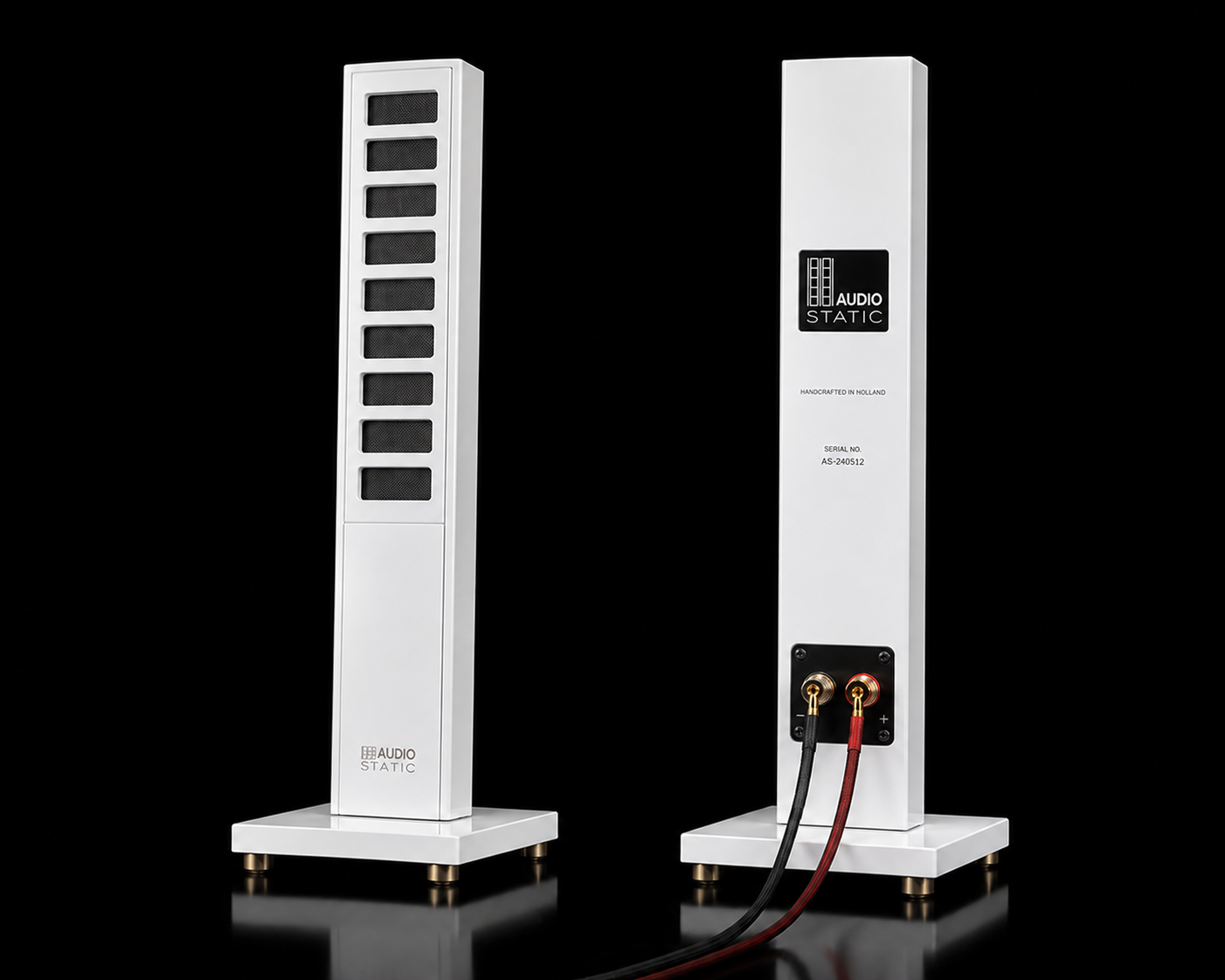
Magnetostatic Speakers
The Precision of Planar Magnetic Sound Reproduction
Magnetostatic speakers, also known as planar magnetic loudspeakers, use a fundamentally different operating principle from conventional dynamic speakers.
Instead of relying on a traditional cone, voice coil and magnet assembly, a magnetostatic loudspeaker uses a very thin and lightweight diaphragm with conductive traces distributed across its surface.
This diaphragm is positioned within a carefully controlled magnetic field.
When the audio signal passes through the conductive pattern on the membrane, electromagnetic forces move the diaphragm forwards and backwards.
Because the driving force is distributed across a large part of the diaphragm surface, magnetostatic speakers can reproduce music with exceptional speed, control, transparency and low distortion.
For many audiophiles, planar magnetic loudspeakers offer a compelling combination of precision, dynamics and natural sound reproduction.
How Do Magnetostatic Speakers Work?
A conventional loudspeaker uses a voice coil attached to a cone.
The voice coil moves within a magnetic field and transfers this movement mechanically to the cone.
A magnetostatic speaker works differently.
The conductive pattern is distributed across the diaphragm itself.
Magnets positioned around or alongside the membrane create a magnetic field.
When current from the audio signal flows through the conductor, the interaction between the electrical current and the magnetic field creates force across the diaphragm.
The membrane moves in direct response to the music signal.
Because the force is distributed over a much larger area than in a conventional dynamic driver, the diaphragm can move with remarkable uniformity.
This operating principle is one of the main reasons planar magnetic speakers are known for their speed, clarity and controlled behaviour.
A Lightweight Planar Diaphragm
The diaphragm of a magnetostatic loudspeaker is extremely light.
This low moving mass allows the membrane to accelerate and decelerate very quickly.
Fast transients can therefore be reproduced with excellent accuracy.
The leading edge of a piano note, the strike of a percussion instrument or the plucking of a guitar string can retain their natural attack and timing.
At the same time, the diaphragm can stop rapidly when the musical signal stops.
This contributes to a clean and controlled presentation with minimal smearing.
The result is not simply more detail.
It is greater accuracy in the way musical information is reproduced over time.
Distributed Drive Across the Diaphragm
One of the most important characteristics of magnetostatic speaker technology is distributed drive.
In a conventional loudspeaker, the cone is driven from a relatively small area around the voice coil.
The rest of the cone must follow this movement mechanically.
In a planar magnetic loudspeaker, the conductive traces are distributed over a large part of the diaphragm.
This means the driving force is applied across the membrane itself.
The diaphragm can therefore move more uniformly.
This reduces unwanted deformation and helps maintain accuracy, particularly during complex musical passages.
It is one of the reasons high-quality magnetostatic loudspeakers can sound exceptionally clean and composed.
Speed and Control
Magnetostatic speakers are known for their fast transient response.
Because the diaphragm is lightweight and the force is distributed across a large area, the membrane can respond rapidly to changes in the audio signal.
This is especially important when reproducing complex music.
A loudspeaker must be able to follow multiple instruments simultaneously without losing definition.
A well-designed magnetostatic system can reproduce these changes with excellent control.
Fast does not mean aggressive.
True speed means that the diaphragm starts and stops precisely when required.
The result can be detailed, dynamic and highly refined at the same time.
Transparency and Detail
High-quality planar magnetic speakers can reveal a remarkable amount of low-level musical information.
Subtle differences in tone, dynamics and ambience remain clearly audible.
This can include:
the texture of a singer’s voice;
the movement of a bow across a string;
the resonance of an acoustic instrument;
the decay of cymbals and percussion;
the natural reverberation of the recording space;
small differences in dynamics;
precise spatial information between instruments.
The goal is not to exaggerate detail.
The goal is to preserve the information already present in the recording.
Natural Midrange Reproduction
The midrange is one of the most critical parts of the audible spectrum.
This is where much of the information contained in human voices and acoustic instruments is located.
A magnetostatic diaphragm can reproduce this region with exceptional clarity.
Because the membrane is lightweight and evenly driven, vocal reproduction can sound open, immediate and natural.
The same characteristics benefit instruments such as piano, guitar, strings, brass and woodwinds.
A good planar magnetic loudspeaker allows differences in texture and harmonic structure to remain intact.
This contributes strongly to the realism of the listening experience.
Large Radiating Surface
Magnetostatic speakers typically use a much larger radiating surface than conventional dynamic drivers.
This large surface area allows the loudspeaker to move the required amount of air while using relatively small diaphragm excursions.
Small excursions help the membrane remain within a more controlled operating range.
This can reduce distortion and improve linearity.
The large panel also creates a different interaction with the listening room compared with conventional box loudspeakers.
The result can be a wide and stable soundstage with excellent image precision.
Dipole Sound Radiation
Many magnetostatic speakers operate as dipole loudspeakers.
This means sound is radiated both forwards and backwards from the panel.
There is often no conventional enclosed cabinet around the diaphragm.
This open construction can contribute to a spacious and natural presentation.
The rear radiation interacts with the listening room and can help create a strong sense of depth.
When correctly positioned, magnetostatic speakers can produce an immersive three-dimensional soundstage.
Instead of hearing sound coming directly from the loudspeakers, voices and instruments can appear naturally within the listening space.
Low Distortion
The operating principle of a planar magnetic loudspeaker offers several advantages when it comes to distortion.
The diaphragm is lightweight.
The driving force is distributed.
The membrane requires relatively little movement.
There is no conventional cone attached to a concentrated voice coil.
Together, these characteristics can reduce mechanical deformation and unwanted resonance.
A properly designed magnetostatic loudspeaker can therefore reproduce complex musical signals with exceptional cleanliness.
Even at higher listening levels, individual musical elements can remain clearly separated and controlled.
Planar Magnetic Speakers and Dynamics
Magnetostatic loudspeakers are often associated with refinement and transparency, but they can also be highly dynamic.
The distributed drive system allows the diaphragm to respond rapidly to changes in level.
Soft passages can remain delicate and detailed, while sudden musical peaks can be reproduced with authority.
This contrast between quiet and loud is an essential part of realistic music reproduction.
A high-quality planar magnetic speaker should therefore not only reveal small details.
It should also preserve the full dynamic expression of the performance.
Open-Baffle Character
Many magnetostatic speakers use an open-baffle or panel-based construction.
Without a conventional enclosure surrounding the radiating surface, there is less cabinet-related energy storage.
This can contribute to an open and unrestricted character.
Box coloration is reduced or eliminated around the planar driver itself.
The result can be a presentation that feels less attached to a physical enclosure.
For many listeners, this contributes significantly to the natural character of planar magnetic sound reproduction.
Engineering a Magnetostatic Loudspeaker
The apparent simplicity of a planar diaphragm between magnets can be misleading.
High-performance magnetostatic loudspeaker design requires careful engineering.
Important parameters include:
diaphragm thickness;
membrane material;
conductive trace geometry;
magnetic field strength;
magnet positioning;
diaphragm tension;
conductor resistance;
panel dimensions;
magnetic uniformity;
mechanical rigidity;
resonance control;
acoustic damping;
dispersion;
electrical impedance;
crossover integration.
All these elements interact.
Changing one parameter can influence efficiency, frequency response, distortion and dynamics.
The final performance is therefore determined by the complete system rather than by the diaphragm alone.
Magnetostatic Speakers and Room Placement
Room placement is particularly important with large planar magnetic loudspeakers.
Because many designs operate as dipoles, their distance from the rear wall has a significant influence on the sound.
Placement affects:
soundstage depth;
stereo imaging;
bass response;
tonal balance;
vocal placement;
spatial realism.
The angle of the panels relative to the listening position is equally important.
Small adjustments can often produce significant changes in focus and imaging.
For the best performance, planar magnetic loudspeakers should therefore be positioned as part of the complete acoustic system rather than simply placed where conventional speakers previously stood.
Magnetostatic vs Conventional Loudspeakers
The main difference between a magnetostatic speaker and a conventional loudspeaker is the way the diaphragm is driven.
A conventional driver uses a concentrated voice coil attached to a cone.
A magnetostatic loudspeaker distributes the conductor across a large part of the diaphragm.
This creates a more evenly driven surface.
The result can offer several audible advantages:
faster transient response;
lower moving mass;
reduced mechanical deformation;
excellent detail retrieval;
clean midrange reproduction;
low distortion;
large-scale sound reproduction;
precise stereo imaging.
These characteristics make planar magnetic speakers particularly attractive to serious music listeners and audiophiles.
Magnetostatic vs Electrostatic Speakers
Magnetostatic and electrostatic loudspeakers share several characteristics.
Both use a large, lightweight diaphragm.
Both can offer exceptional speed, transparency and detail.
Both are often used in open dipole configurations.
The main difference lies in the way the diaphragm is driven.
An electrostatic speaker uses an electrically charged diaphragm positioned between stators and driven by an electrostatic field.
A magnetostatic speaker uses electrical current flowing through conductive traces within a magnetic field.
Both technologies are capable of exceptional performance, but each has its own engineering characteristics and sonic presentation.
Why Choose Magnetostatic Speakers?
The attraction of magnetostatic loudspeakers comes from the combination of several important qualities:
low moving mass
distributed diaphragm drive
fast transient response
high resolution
low distortion
natural midrange reproduction
excellent dynamics
precise stereo imaging
open dipole radiation
a spacious and three-dimensional soundstage
Together, these properties create a listening experience that can be both analytical and deeply musical.
When the Speaker Disappears
Ultimately, the purpose of any high-end loudspeaker is not to draw attention to the technology.
It is to reproduce music convincingly.
A properly engineered magnetostatic loudspeaker can create a soundstage in which voices and instruments appear independently from the physical speaker panels.
The loudspeaker becomes less noticeable.
The recording becomes more believable.
And the listener becomes more connected to the performance.
That is the essence of planar magnetic sound reproduction.